ChatGPT
 Perplexity AI
 Claude
Embarking on a path to a career in the dynamic hospitality scene? A solid hospitality resume is your golden ticket. In this guide, we serve up key ingredients needed to brew an application that stands head and shoulders above the rest.


 See more examples like these
Featuring invaluable tips, practical examples, and sample resumes, we'll help you carve a resume that not only charts your professional journey but also highlights your inner people-person skills.
So, ready to cook up a storm with your resume? Keep reading to learn the following steps:
- Learn from the wins and losses of real-life hospitality resume samples
- Choose the correct format for a hospitality resume
- Write a compelling resume summary that grabs the attention of hospitality employers
- List skills that are specific to the hospitality industry
- Optimize your work experience section to showcase your hospitality strengths
- Properly include your educational credentials in hospitality
- Add optional sections to your hospitality resume (if needed)
- Find useful job search resources for hospitality professionals
Hostess resume example


Why does this resume example work?
- Easy-to-read layout: This resume has a nice, clean structure that makes it simple to scan. Each section is clearly labeled, and the spacing gives everything room to breathe. Recruiters can quickly see the applicant’s career progression and skills without feeling overwhelmed by clutter.
- Focused work experience section: Every entry in the experience section keeps customer interaction front and center, which is a smart move. The applicant highlights moments of direct engagement, like coordinating special events, managing customer concerns, and maintaining service standards under pressure. It shows a solid understanding of what makes this industry tick.
What could be improved?
- Moving personal information into the header: Right now, the contact details take up a bit too much space at the top. Moving them into a simple header would free up room for more valuable content, like an extra skill or an expanded description of achievements.
- Making the hobbies section more relevant: While hobbies like “traveling abroad” and “writing” are interesting, they don’t do much to strengthen this specific application. It would be better to mention interests that tie back to hospitality, such as learning about new cuisines, volunteering at local events, or exploring customer service trends. That way, the hobbies section feels intentional and helps reinforce the idea that the applicant is genuinely passionate about this field.
Hotel concierge resume example

Why does this resume example work?
- Varied and well-organized skills section: This skills section is one of the strongest parts of the resume. It’s neatly divided into categories (languages, computer skills, and interpersonal skills), which makes it super easy to read. The variety also shows that the applicant is a well-rounded professional.
- Clear use of action verbs: Every bullet in the experience section starts with a strong, active verb like “delivered,” “coordinated,” and “managed.” That helps the resume sound dynamic and confident instead of flat or repetitive. It also makes it easier for the reader to picture what the applicant actually did in each role.
What could be improved?
- Adding quantifiable data: The experience section lists strong responsibilities, but it would stand out even more with a few numbers. For example, the applicant could mention how many guests they assisted daily, the size of the events they coordinated, or the percentage of positive guest feedback they received. Quantifiable data makes achievements feel more concrete and helps the hiring manager see the scope of the candidate’s work at a glance.
- Updating the education section: The education entry is clear, but it takes up more space than it needs to. While it’s nice to see club involvement, the details could be shortened to make room for more recent or job-relevant information. A short mention of teamwork or leadership skills would be enough to get the point across without losing valuable space for experience or achievements.
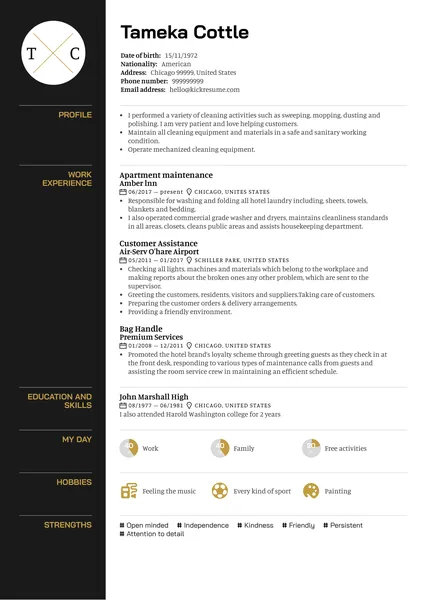
Front desk resume sample

Why does this resume example work?
- Inclusion of a volunteering section: Adding a volunteering section is a great move. It shows that the applicant is involved in their community and is motivated by more than just work. It also gives employers a sense that the candidate has strong values and can connect with people in a genuine way, which is a big plus in any customer-facing role.
- Evidence of leadership and training experience: The candidate mentions training new cleaners and employees in multiple roles, which shows leadership potential and reliability. It also suggests they have strong communication and organizational skills. Employers value applicants who can help onboard and support others, especially in fast-paced hospitality settings where teamwork makes all the difference.
What could be improved?
- Sharing less personal information: Including nationality and date of birth isn’t necessary and can actually work against the applicant. Those details don’t add value to a hiring decision and, in some cases, can even lead to unconscious bias. It’s always safer and more professional to leave that kind of information out.
- Making the profile section more informative: The profile feels a bit too general for how much good experience this candidate actually has. Since the rest of the resume already includes solid, measurable achievements, the opening could be stronger if it mentioned one or two of those wins. Something like “Recognized for improving guest satisfaction by 30 percent and boosting sales by 27 percent” would make a great hook and help the reader understand what makes this applicant stand out.
1. Choose the correct format for a hospitality resume
The first step to creating an effective hospitality resume that will win the job of your dreams is to choose the best format for your experience level.
Ideally, you should employ the reverse-chronological format – a resume format that prioritizes work experience above all else. With this resume, the work experience section becomes the crown jewel of the document, forming the largest and most central part of the resume.
However, the RC resume is less than ideal for candidates seeking entry-level positions who do not have an extensive background in hospitality.
In this case, there are two alternative formats to consider
- Functional resume: The functional resume is designed for applicants who are recent graduates and lack relevant work history. Rather than focusing on work experience, this resume focuses on education, skills, and unpaid experience.
- Hybrid resume: The hybrid resume combines elements of both functional and reverse-chronological resumes.
Focus is split relatively evenly between all sections, making it easier for applicants who are changing career paths or working around gaps in their work histories to create a compelling resume.
A few additional formatting tips
- Choose a clean, easy-to-read font like Calibri, Georgia, or Arial
- Set your font size between 10 and 12 points
- Keep it to one page if you can; two max if your experience really calls for it
- Break your resume into clear sections with headings like “Experience” or “Education”
- Use bullet points instead of long paragraphs (they’re faster to scan)
- Keep your margins consistent, around 0.75 to 1 inch on all sides
- Make sure there’s enough white space (crowded text is hard to read)
- Always save and send your resume as a PDF, unless the job posting specifically asks for another format
And if formatting isn’t your favorite part of the job search, feel free to check out our professionally designed resume templates. The less time you spend on formatting, the more you can focus on perfecting your content.
Try our AI Resume Writer and have your resume ready in minutes!

2. Write a compelling summary that grabs the attention of hospitality employers
The first thing anyone sees on your resume is the short paragraph sitting right under your name and contact details. That little section is called your resume summary or resume objective.
Both versions have their place, and the right choice depends on where you are in your career. But before we get into that, let’s talk about why this part matters so much.
Hiring managers in hospitality read dozens, sometimes hundreds, of resumes. They’re scanning quickly to see who stands out. A strong opening helps them understand who you are, what you can do for them, and whether it’s worth taking a closer look.
When to use a resume summary
If you already have solid experience in hospitality, a resume summary is the way to go. It’s meant for professionals who can point to clear achievements and established skills.
Your summary should include:
- Your current role or job title
- Years of experience
- Type of establishment or area of expertise (e.g., hotels, restaurants, events, guest relations)
- Key strengths that fit the role you’re after
- A standout achievement or recognition
This section is where you lead with what you’ve done, NOT what you hope to do.
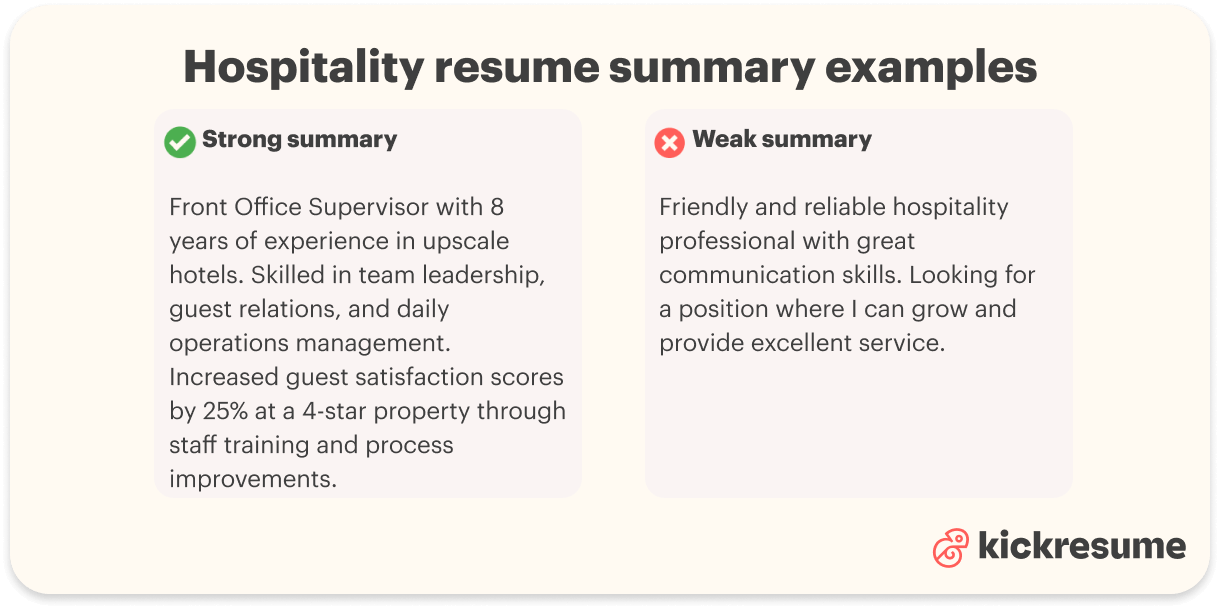
Bad hospitality resume summary example
Friendly and reliable hospitality professional with great communication skills. Looking for a position where I can grow and provide excellent service.
Why doesn’t this work? Because it says almost nothing. There’s no job title, no experience level, and no sense of what this person actually does well. It could describe anyone.
Good hospitality resume summary example
Front Office Supervisor with 8 years of experience in upscale hotels. Skilled in team leadership, guest relations, and daily operations management. Increased guest satisfaction scores by 25% at a 4-star property through staff training and process improvements.
What makes this one better? It’s clear, specific, and full of substance. You can immediately picture what this person does and how they make a difference.
When to use a resume objective
If you’re new to hospitality, changing careers, or reentering the workforce, a resume objective might fit better. Objectives focus on where you’re heading and what you hope to bring to the role.
Use an objective if:
- You’re starting your hospitality career (e.g., recent graduate or trainee)
- You’re changing careers (say, from retail or tourism into hospitality)
- You’re returning to work after time away
Even though objectives are more forward-looking, they still need to be specific. Mention your direction, relevant skills, and what you can offer an employer.
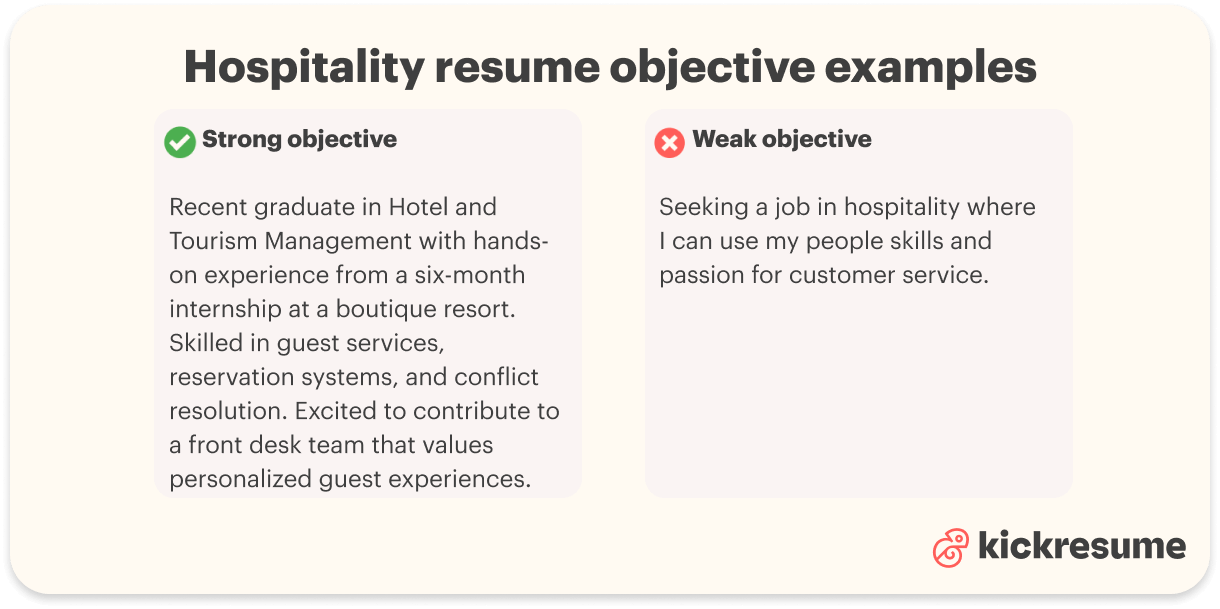
Bad hospitality resume objective example
Seeking a job in hospitality where I can use my people skills and passion for customer service.
Why isn't this enough? This one falls flat because it’s vague and generic. It could belong on any resume.
Good hospitality resume objective example
Recent graduate in Hotel and Tourism Management with hands-on experience from a six-month internship at a boutique resort. Skilled in guest services, reservation systems, and conflict resolution. Excited to contribute to a front desk team that values personalized guest experiences.
Why does this one sound stronger? Because it gives a real sense of experience, skills, and direction. It tells the employer who this person is and what they’re ready to do next.
A few final tips
- Skip personal pronouns like “I” or “my.”
- Avoid filler phrases such as “hardworking” or “team player.” Instead, show it through what you’ve done.
- Name your area of hospitality right away, so it’s instantly clear whether you’re a fit.
- Keep it short — 3 to 5 lines is enough.
Your summary or objective is your first impression. Make it count by showing exactly what kind of professional you are and what value you bring. Once the reader sees that, they’ll want to know more.
3. List skills that are specific to the hospitality industry
When writing your hospitality resume, it is important to include both soft and hard skills.
Soft skills are your interpersonal, people skills. These abilities are highly important and valued within hospitality, as most of the positions deal with working directly with customers. However, including hard skills can be equally important to employers.
Hard skills are your technical skills and abilities that showcase your competence within a hospitality position. These skills are often learned through education or training.
Best hard skills to include in a hospitality resume
- Basic Computer Skills
- Vendor Relations
- Event Planning
- Hospitality Industry Knowledge (Current trends, regulations, etc.)
- Scheduling and Bookkeeping
- Front Desk Management
- Sales and Upselling
- POS Systems
- Bilingualism
- Social Media Marketing and Networking
Effective soft skills to put on your hospitality resume
- Attention to Detail
- Active Listening
- Conflict-Resolution and Problem-Solving
- Verbal Communication
- Telecommunication
- Multi-Tasking
- Empathy
- Flexibility and Adaptability
- Negotiation
- Teamwork
Find out your resume score!

4. Optimize your work experience section to showcase your hospitality strengths
Hospitality jobs can involve a lot of moving parts. Guest service, teamwork, multitasking, daily operations, and problem solving all happen at once. So it’s easy to feel like your work experience section should list everything you did in every role.
But your goal is to highlight the parts of your experience that show the employer you are ready to thrive in their environment.
Consider what to emphasize depending on the job you’re applying for:
- Going for a front desk or guest-facing role? Highlight customer service, communication, conflict resolution, and positive feedback scores.
- Applying to a restaurant role? Focus on speed, accuracy, service quality, and teamwork.
- Looking at a management or supervisor position? Show leadership, staff training, operations improvements, budgeting, and guest experience results.
- Interested in events or concierge work? Emphasize coordination, organization, upselling, and personalizing guest experiences.
How to structure your work experience section
For each role, include:
- Your job title and company name
- Location and dates of employment
- Bullet points showing your responsibilities and results
- Proof wherever possible (numbers, improvements, guest ratings, efficiency, etc.)
Always try to focus on results and outcomes, not just tasks!!!
Bad hospitality work experience example
Server
Seaside Grill
June 2021 – Present
- Took orders and delivered food
- Handled customer service
- Worked with team
- Closed out checks
What’s missing here? Everything feels generic. There is no sense of the pace, the level of service, or how well the person performed.
Good hospitality work experience example
Server
Seaside Grill
June 2021 – Present
- Served an average of 60+ guests per shift in a high-volume coastal restaurant while maintaining consistent service quality
- Achieved a 98 percent positive satisfaction score on guest comment cards over two seasons
- Trained four new servers on menu knowledge, service standards, and POS procedures
- Recognized as Employee of the Month twice for teamwork and guest care
Tips for students, interns, and newcomers to the profession
If you’re an early-career academic your experience might look a bit lighter. That’s totally fine. Focus on what you have done, and frame it with confidence.
Here’s an example of how to do that:
Good example for those starting out or still building experience
Front Desk Associate (Intern)
Bayview Resort
January 2023 – June 2023
- Assisted guests with check-in and check-out using Opera PMS
- Handled room requests and inquiries while maintaining a welcoming and calm atmosphere
- Helped resolve guest issues and followed up to ensure satisfaction, contributing to positive online review mentions
- Coordinated with housekeeping to support smooth daily room turnover
Before you finalize this section, read the job description again. Look for the keywords and qualities they care about. Shape your bullet points around those needs.
The clearer the match between your experience and the role, the easier it is for the hiring manager to picture you in the job. And once they can picture you there, you are already halfway to the interview!
5. Properly include your educational credentials in hospitality
When listing your education on a hospitality resume, you should always list your highest level of education, as well as the school or institutions you graduated from.
Along with properly listing your education, it is also beneficial to list any relevant hospitality certifications you have earned.
We highly recommend seeking out certifications in the hospitality industry, as completing certification programs helps you to gain a much more competitive edge against other applicants.
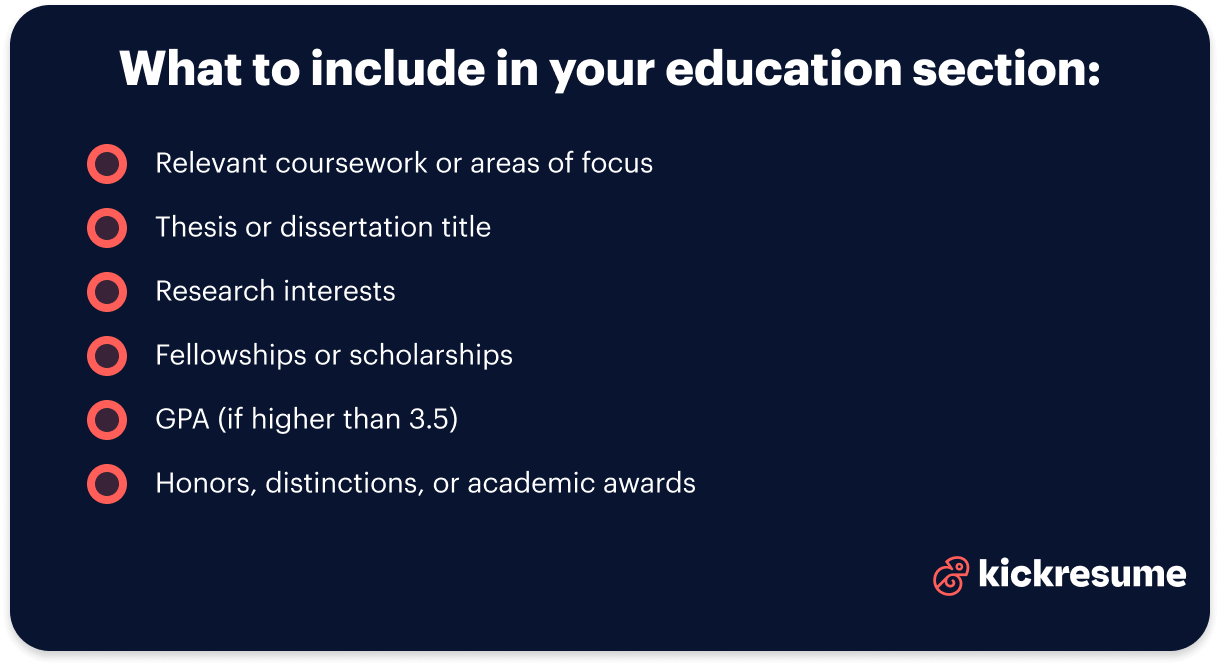
Here is an example of a well-crafted education section on a hospitality resume
Education
B.A. in Hospitality Management | Duke University
- Major: Hospitality Management and Business Administration
- Graduated: 2017
- GPA: 3.6
Certifications
- Certified Hotel Administrator (CHA) | American Hotel and Lodging Educational Institute
- Certified Hospitality Supervisor | American Hotel and Lodging Educational Institute
6. Add optional sections to your hospitality resume (if needed)
Once you’ve included the main parts of your resume, you technically have everything you need. But sometimes you have a little more to offer that doesn’t quite fit under work experience, skills, or education.
Optional sections help you highlight things that strengthen your application and make you more memorable. The key is to choose them thoughtfully, not just to fill space.
When to include optional sections
Add an extra section if:
- It clearly supports the kind of hospitality job you’re applying for
- You still have room on the page and everything feels clean and easy to read
- It helps show off strengths, qualities, or interests that matter in the role
Leave these sections out if:
- You’re adding something just to make your resume look longer
- The information is interesting but not relevant
- It distracts from your main experience instead of supporting it
Your resume should feel focused. Anything that doesn’t help your case can be left out.
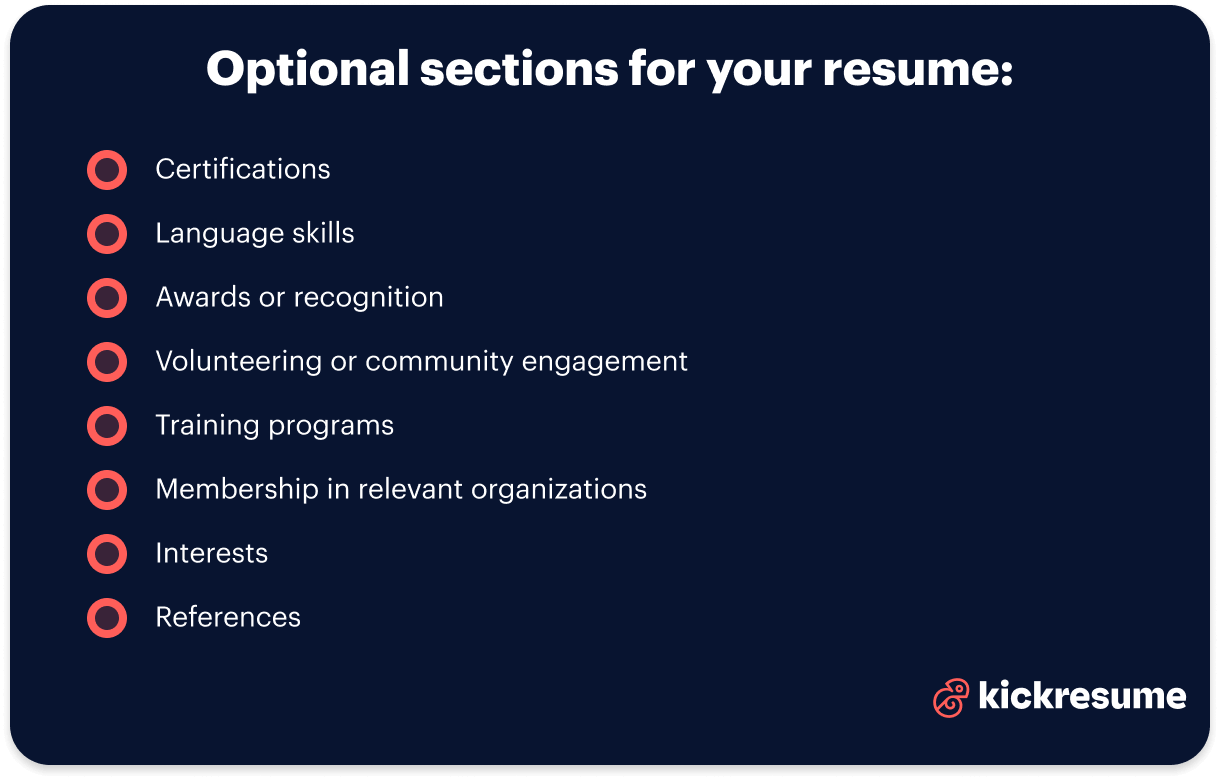
Optional sections commonly used in hospitality resumes
Here are some ideas worth considering:
- Certifications (food safety, wine knowledge, first aid, customer service training)
- Language skills (especially useful in hotels, resorts, and tourist areas)
- Awards or recognition (employee of the month, service excellence awards, guest satisfaction bonuses)
- Training programs (brand training, leadership development, barista or mixology courses)
- Volunteer or community involvement (especially if it demonstrates customer service or teamwork)
- Professional memberships (hospitality associations, tourism networks, culinary clubs)
- Interests (only if they show personality that fits hospitality, such as travel, food culture, hosting events)
Example of optional sections in a hospitality resume
Certifications
- ServSafe Food Handler Certification (2024)
- Wine & Spirit Education Trust (WSET) Level 1 (2023)
Awards & Recognition
- Employee of the Month, Harborview Hotel (July 2022, March 2023)
- Guest Service Recognition Pin, Marriott Brand Program (2021)
Languages
- English (Fluent)
- Spanish (Conversational)
Optional sections are about rounding out your profile in a way that gives the reader a fuller sense of who you are and how you work. If the section adds value, include it. If it doesn’t, let it go. Simple as that.
7. Avoid silly mistakes when writing your hospitality resume
You can have years of solid experience, glowing references, and the right certifications, and still get passed over because of small, easy-to-fix resume mistakes.
Here's what to watch out for:
#1 Typos and spelling errors
This one's a classic, but it still trips people up. Hospitality is full of tricky words like "concierge," "sommelier," "hors d'oeuvres," and writing them as "concirge" or "sommilier" is the kind of small thing that makes a hiring manager raise an eyebrow. Same goes for the basics, like misspelling "restaurant" or "hospitality" itself.
#2 Vague job descriptions
"Provided excellent customer service" is the resume equivalent of "good vibes." It sounds nice, but it tells the employer absolutely nothing. Every applicant says they provide great service. What did you actually do?
#3 Overloading the resume with irrelevant experience
If you're applying for a hotel front desk role, your two-week stint at a car wash from 2014 probably isn't pulling its weight. Cramming in every job you've ever had pushes your actually-relevant experience further down the page. And recruiters rarely scroll that far.
#4 Using the same resume for every job
A barista role and a hotel manager role are very different beasts, even if they both live under the hospitality umbrella. Sending the same generic resume to both is a fast way to land in the "no" pile for either one.
#5 Listing duties without results
"Greeted guests at the door" is a task. "Greeted 200+ guests per shift while maintaining a 4.9-star Google rating" is an achievement. Hospitality is a results-driven industry, and hiring managers want to see what your work actually did for the business.
#6 Ignoring soft skills
Hospitality runs on soft skills. You can be the fastest server in the world, but if you can't read a table or stay calm when a guest is unhappy, the rest doesn't matter much. And yet, plenty of resumes only show off the technical stuff.
#7 Poor formatting and layout
A cluttered, hard-to-read resume is a recruiter's nightmare. Mixed fonts, walls of text, weird spacing, neon colors…all of it makes your resume harder to skim. And skimming is exactly what hiring managers do.
#8 Skipping keywords from the job ad
A lot of hospitality employers, especially big hotel chains, use ATS software to filter applications before a human ever sees them. So if the job ad asks for "Opera PMS" and your resume only mentions "hotel booking software," you might get filtered out before anyone reads a word.
#9 Adding information that doesn't matter
Listing hobbies like "video games" or "watching movies" on a hospitality resume doesn't really help your case. Same with overly personal details like your photo, marital status, or date of birth. None of it tells the hiring manager whether you can run a busy floor.
Small mistakes can undo a lot of hard work. Catching them before you apply can be the difference between a callback and silence.
8. Essential job search resources for hospitality professionals
Stepping into the bustling world of the hospitality industry, it's vital to have the right resources on hand to secure your next great role. Here's a curated list of top job search tools tailored specifically for those cooking up a career in hospitality:
- Hospitality job boards: Harness the power of hospitality-focused job boards like Hcareers, Hospitality Online, and Caterer.com to uncover a buffet of job opportunities suited to your unique skills and experience.
- Professional networking sites: LinkedIn should be your go-to for establishing connections and seeking job vacancies, but remember to also explore industry-specific networking sites like Hosco.
- Hospitality associations: Membership in associations like the American Hotel & Lodging Association can put you in touch with excellent networking opportunities, career development initiatives, and potential job leads.
- Hospitality trade shows and conferences: These events offer you a chance to network, stay on top of industry trends, and sometimes even find job openings. Events like the International Hotel Investment Forum can be invaluable.
- Online learning platforms: Websites like Coursera, Lynda, and Khan Academy offer many hospitality-related courses that can boost your knowledge and resume.
Armed with these resources, embark on your mission to find the perfect hospitality role that season your career just right.
Hospitality Career Outlook in 2026
The hospitality industry covers multiple sub-sectors, and each one is moving at a slightly different pace.
Here’s a brief overview of the projected growth in key sub-sectors of hospitality between now and 2033 based on the U.S. Bureau of Labour Statistics projections:
- Food Preparation & Serving: Projected to grow about as fast as average, with about 2.6 million openings per year on average. Within this group, some roles are growing faster than average—for example: Bartenders: +6% projected growth with about 129,600 openings/year, Chefs and head cooks: +7% projected growth with about 24,400 openings/year.
- Recreation: Projected to grow 4% (as fast as average), with about 68,100 openings/year.
- Animators: Projected to grow 2% (slower than average), with about 5,000 openings/year.
- Lodging: Projected to grow 3% (as fast as average), with about 5,400 openings/year.
Moreover, AI is increasingly used behind the scenes in hospitality operations. For example, in Toast’s 2025 restaurant survey, operators reported using AI for automating marketing (28%), getting real-time insights (27%), and optimizing menus (26%)—which hints at where the day-to-day work is heading (more data, more automation).
Average US base salaries across popular Hospitality roles:
- Animator: $47,225/year (excl. tips)
- Bartender: $55,222/year (excl. tips)
- Chef: $57,751/year
- Concierge: $49,722/year (excl. tips)
- Food Preparation Worker: $35,083/year
- Hotel Manager: $64,619/year
- Housekeeper: $45,986/year (excl. tips)
- Restaurant Manager: $60,736/year
- Server: $51,436/year (excl. tips)
Salary estimates are based on data from Indeed as of January 2026, combining anonymized salary submissions and job posting data. Actual salaries may vary depending on location, company size, and experience level—and in many hospitality roles, tips can significantly change total earnings.
Hospitality Resume FAQ
What specific skills should I highlight in my hospitality resume?
Empathy, customer service, communication, ability to work in a team, and problem-solving skills are all key in the hospitality industry. Don't forget to highlight specific technical skills such as proficiency in a foreign language or familiarity with hospitality software.
Should I include volunteer experience in my hospitality resume?
Absolutely, especially if it's relevant. For example, volunteering at a local food bank demonstrates customer service and teamwork skills, both of which are valuable in hospitality.
I've only worked in one hospitality role. How can I make my resume stand out?
Focus on the responsibilities you had and the results you achieved. Did you receive positive customer feedback? Improve a process? These accomplishments make you stand out.
How can I show career progression in my hospitality resume?
Highlight promotions, increased responsibilities, or successful projects you have completed. This demonstrates your growth and value as an employee.
I'm switching from another industry. How can I make my past experience relevant to a hospitality role?
Identify transferrable skills from your past roles. Did your previous job require customer service, multitasking, or teamwork? These are relevant in hospitality.







![Modelo Curriculum Vitae Hostess [PT]](https://d1xn1bcogdo8ve.cloudfront.net/275/thumbnail.webp)


![How to Write a Professional Resume Summary? [+Examples]](https://d2xe0iugdha6pz.cloudfront.net/article-small-images/How_to_Write_a_Professional_Resume_Summary_.png)

![How to Describe Your Work Experience on a Resume? [+Examples]](https://d2xe0iugdha6pz.cloudfront.net/article-small-images/How_to_Describe_Your_Work_Experience_on_a_Resume_.png)